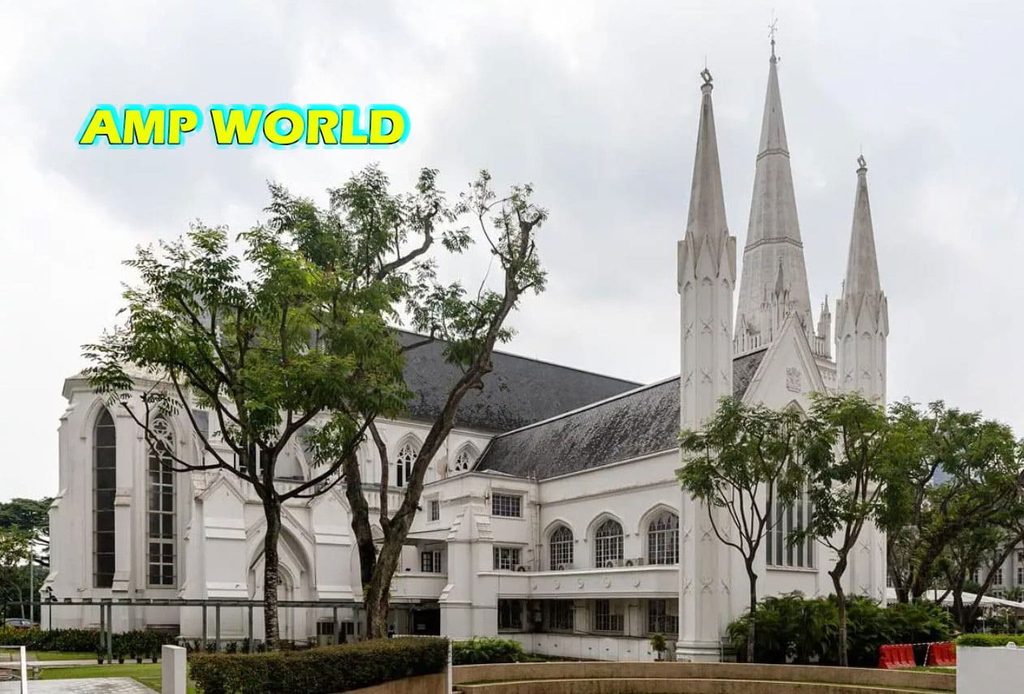
St Andrew’s Cathedral is located at 11 St Andrew’s Road, next to the City Hall MRT Station in Singapore. It is an Anglican church named after the patron saint of Scotland. As the oldest Anglican place of worship in Singapore, it was designated a national monument in 1973. Designed by Lieutenant Colonel Ronald MacPherson, the cathedral was built with the labor of convicts from India.
St Andrew’s Cathedral has a long history and reflects the spread of Anglicanism throughout the region. It also highlights the roles played by the Scottish, English, and Indian communities in shaping Singapore during the colonial era, serving as an important part of the city-state’s religious and cultural heritage.
The foundation stone of the first church was laid in 1835, based on a design by George D. Coleman. The building was completed in 1836 and named in honor of the local Scottish community, who provided the initial funding for its construction according to the NLB. The first service took place in 1837, led by the church’s first minister, Reverend Edmund White. In 1838, Bishop Daniel Wilson of Calcutta presided over the official consecration ceremony of the church.
The first church featured a bell donated by the wife of the United States Consul, Joseph Balestier. Known as the “Revere Bell,” it bore the inscription “Revere Boston 1843” on its surface. In 1842, J. T. Thomson added a tower and a spire; however, the spire was struck by lightning twice. Due to the resulting damage, the church was closed in 1852 as it was deemed no longer safe, and it was subsequently demolished.
The foundation stone of the current cathedral was laid in 1856 by Daniel Wilson, the Bishop of Calcutta. Construction continued until 1864. The building was designed by MacPherson an engineer who also served as the head of the Public Works Department in the English Gothic style. The intricate details were executed by John Bennet, a civil engineer who also designed the Raffles Lighthouse.
The first service in the new building was held in 1861. A year later, the structure was officially consecrated by George E. L. Cotton. In 1870, the church was designated as a cathedral; the ceremony was led by Archdeacon J. A. Beckles as part of the establishment of the United Diocese.
St. Andrew’s Cathedral is one of the few churches in Singapore that still showcases the English Neo-Gothic style. Its bell tower features pointed-arched windows and a soaring spire, bearing a striking resemblance to Salisbury Cathedral in England, reports the National Heritage Board. Beneath the spire lies a covered porch, providing shelter for the congregation and visitors from the heat of the tropical climate.
Madras chunam is a type of plaster frequently used in buildings from the early colonial era. It provides a bright, smooth finish to the walls of cathedrals. The mixture consists of shell lime, egg whites, a coarse sugar known as jaggery, and water in which coconut husks have been soaked. Sometimes, fine soapstone powder is added to the mix, while stones or rock crystals are used to rub the dried walls until the surface acquires a glossy sheen.
The cathedral and its surrounding grounds feature a number of memorials honoring significant figures from Singapore’s past. Stained-glass windows in the apse are dedicated to Raffles, John Crawfurd, and Major General W. B. Butterworth. Another window, located near the main entrance, commemorates the cathedral’s designer and architect, MacPherson.
Several plaques on the north wall pay tribute to those who perished during the 1915 Sepoy Mutiny in Singapore. The cathedral also houses a War Memorial Wing, built to honor military personnel who lost their lives during World War II. This wing was inaugurated in 1952 by General Sir Gerald Templer, the High Commissioner for Malaya.
St. Andrew’s Cathedral is a prominent example of English Neo-Gothic design in Singapore. Its soaring spires, stained glass windows, and historical details reflect a unique style and a rich past. The cathedral remains an important place of worship, as well as an integral part of Singapore’s religious and cultural heritage.